Latest work
My Chemical Harness: LLM-guided molecular design with built-in synthesizability.
Most AI approaches to molecular design optimize for promising structures first and worry about synthesis later. My Chemical Harness builds synthesizability into the search process from the start. Instead of generating molecules in isolation, the system evolves synthetic routes made from purchasable building blocks and validated reaction steps.
The LLM acts as a strategy layer on top of trusted chemistry software. It proposes high-level search directions — such as which reaction families, molecular motifs, or exploration settings to prioritize — while deterministic tools build, check, score, and select the candidates. This separation lets the model guide discovery without relying on hallucinated chemistry, producing molecules that are linked to explicit synthetic routes.
Read the full preprint →Collider-Bench: can language-model agents reproduce a real experimental analysis?
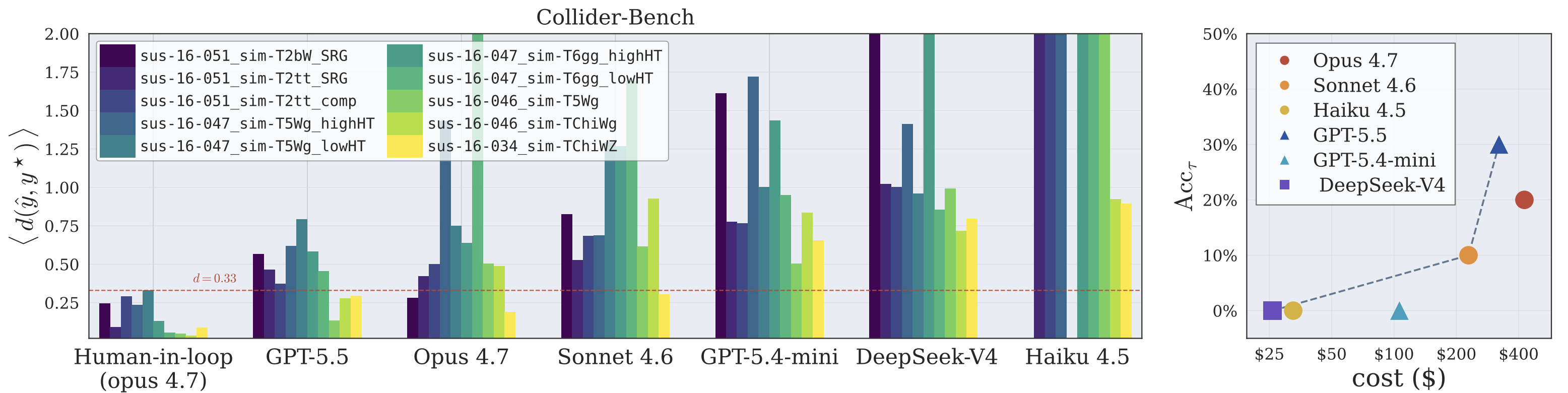
AI agents promise to automate scientific work — but can they actually do it? Collider-Bench tests whether language-model agents can reproduce published Large Hadron Collider analyses using only the public papers and open scientific software, turning each study into an executable pipeline and predicting event yields. Agents are scored on both their numerical results and the quality of their code and reasoning. So far, they struggle to match a physicist guiding the process by hand.
Prior-fitted functional flows for Pharmacokinetics.
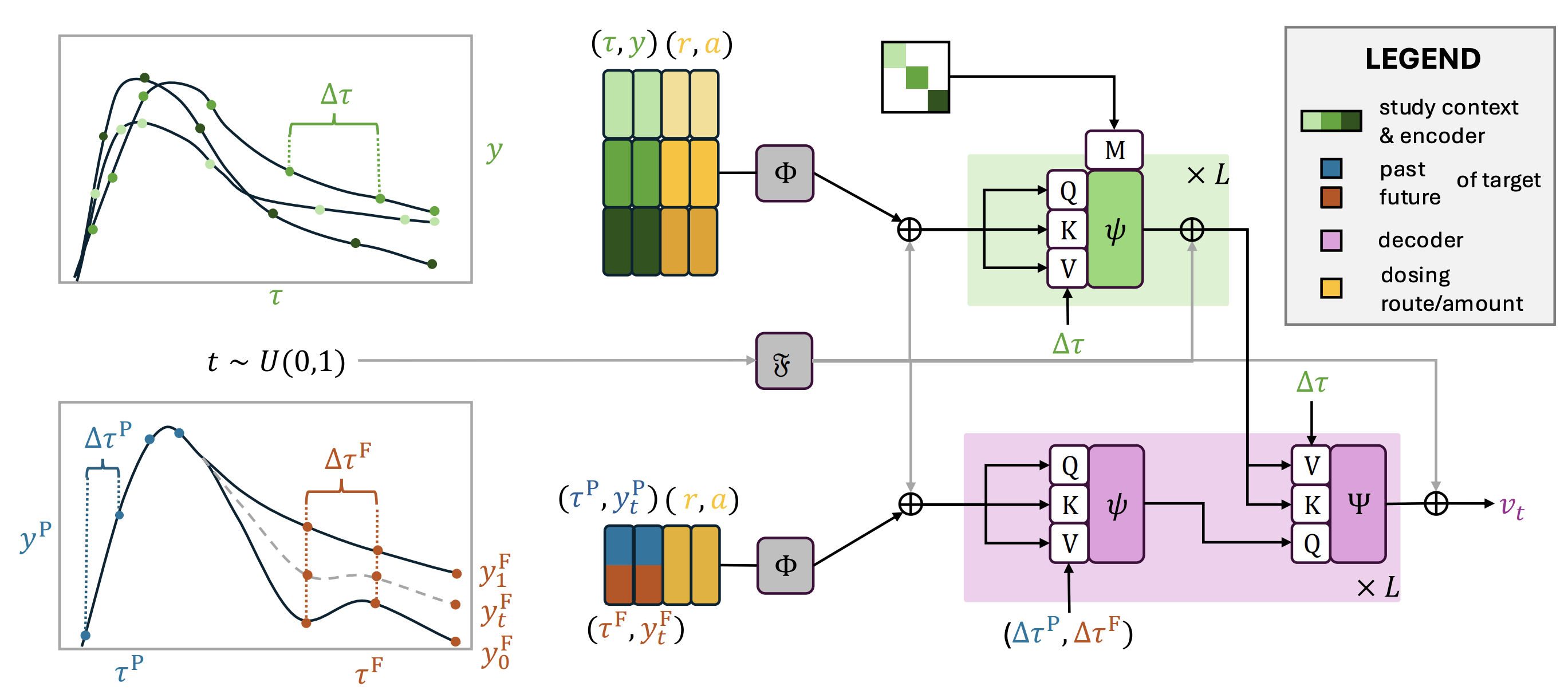
Pharmacokinetics studies how drug concentrations evolve in the body over time. The data are difficult for standard machine learning because clinical studies often include only a small number of patients, and each patient may have just a few irregular concentration measurements. Classical modeling pipelines usually require a pharmacology expert to build and tune a custom model for each new compound.
In this work, we built a zero-shot generative model for pharmacokinetic trajectories. The system is pretrained on simulated studies generated from domain-informed priors, then applied directly to real studies without additional training. From a small patient cohort, it can generate virtual patients, forecast future drug concentrations for a partially observed individual, and return uncertainty estimates.
The method combines transformer-based in-context learning with functional flow matching. Instead of fitting a separate model for each drug, it learns how to infer entire concentration-time functions from sparse context data. This makes the approach closer to a foundation model for pharmacokinetics, using pretraining, context, and scientific priors to replace much of the manual modeling loop. The paper has been accepted to the main conference at UAI 2026.